After listening to the AI lecture and trying ChatGPT: How can SMEs move from individual trials to company-wide implementation?

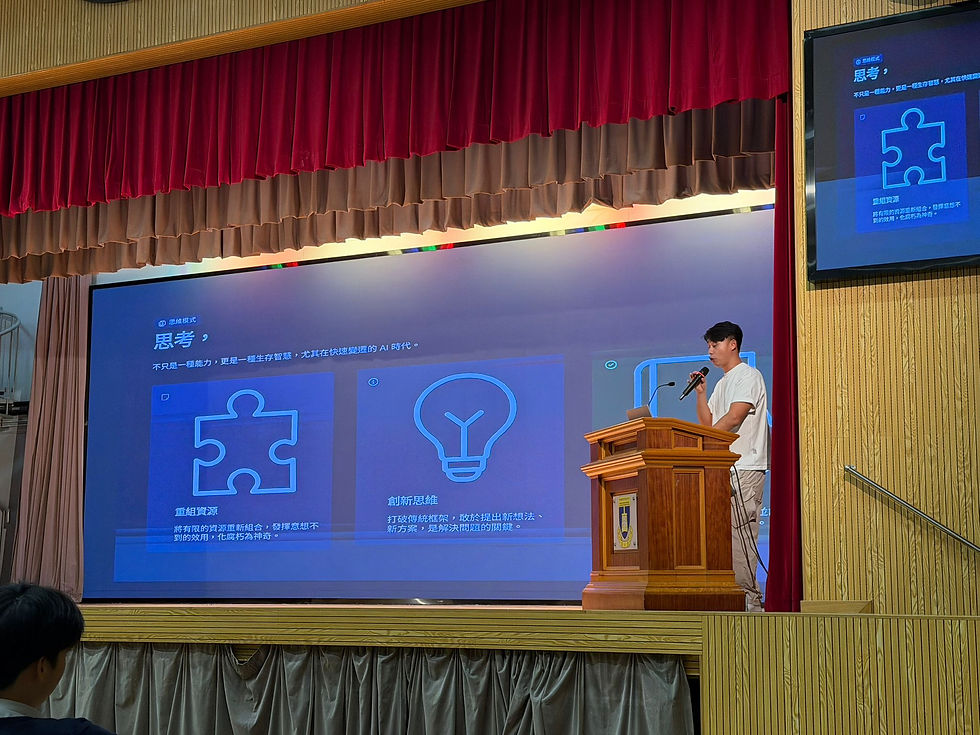
During a recent AI sharing session for SME owners and managers, I noticed a very interesting phenomenon:
Many people are not actually against AI, but rather they don't know where to start.
Some people have heard of ChatGPT, some have started trying Gemini, and some companies have already been using Microsoft 365.
There's a lot of interest in AI, but when the conversation shifts from "What can AI do?" to "How should companies truly implement AI?", many business owners encounter the same problem:
"After listening, I think AI is very useful, but when I get back to the company, where should I start?"
This is precisely the challenge that many small and medium-sized enterprises are currently facing in implementing AI.
According to the SME Survey released by the Hong Kong Productivity Council in the first quarter of 2026 , 55% of the surveyed SMEs have already used or plan to use AI tools in their daily operations within the next year. This indicates that the market has moved beyond the stage of "what is AI" and has officially entered the practical stage of "how AI can be truly implemented in companies".
However, the first step in implementing AI is not necessarily to immediately compare which of ChatGPT, Gemini, or Copilot has the most powerful features, nor is it to ask employees to open accounts and try them out.
For businesses, the more important question should be:
Which workflow does the company want to improve with AI?
AI is not magic, nor is it simply about learning a few prompt techniques. The truly valuable application of AI is enabling humans to work with AI, making repetitive, time-consuming, and error-prone tasks more efficient and systematic.
Here are 5 management issues that SME owners should think about before implementing AI.
1. The first step in AI implementation for SMEs: Ask about the process first, not the tools.
When many companies first get involved with AI, the first question they often ask is:
Should my company use ChatGPT, Gemini, or Copilot?
This is a reasonable question, but it may not be the first question that should be asked.
The more practical question should be:
Which process in the company is the most time-consuming, most repetitive, and most prone to errors?
For example:
After a customer inquires, you need to summarize the key points before preparing a reply.
Sales staff need to regularly write quotation emails or proposals.
After the meeting, you need to organize the Meeting Notes and Action Items.
My colleague needs to convert WhatsApp conversations into internal follow-up lists.
Management needs to quickly read contracts, NDAs, policies, or lengthy reports.
The Admin is responsible for compiling internal company notices, SOPs, or FAQs.
The technical team needs to compile the service records into a customer report.
These routine tasks may not be the most "high-tech," but they are often where the real value of AI is most readily apparent.
If a company simply buys AI tools and tells colleagues to "try using them themselves," it easily becomes a case of everyone using them for their own purposes. Some people use AI to rewrite emails, some use it to summarize documents, and some even paste sensitive information directly. Management will find it difficult to monitor the effectiveness and control the risks.
Therefore, the first step in introducing AI is not choosing tools, but choosing scenarios.
A good starting point for AI usually needs to meet three conditions:
"High frequency, low risk, and easy to verify effectiveness."
For example, tasks such as weekly meeting minutes, customer inquiry compilation, draft quotation emails, and internal FAQ compilation are more suitable as pilot projects than building a large-scale AI system at the beginning.
2. AI will not automatically make a company more systematic.

Many people believe that as long as AI is introduced, company data will naturally become easier to organize.
The reality is quite the opposite.
If a company's data is already scattered, AI will only make the problem more apparent.
For example:
Customer data in Excel
Conversation records in WhatsApp
The file was stored on the colleague's own computer.
Contracts hidden in different email attachments
The quote has multiple Word or PDF versions.
Images, design drafts, and company profiles are scattered across different cloud folders.
Some important data exists only in the personal habits of individual colleagues.
In this situation, even with AI, colleagues still have to spend a lot of time searching for information, checking versions, and determining which one is the latest.
AI excels at organizing, summarizing, categorizing, and rewriting, but only if the company knows where the data is stored, who has the right to use it, and which version is the official one.
In other words:
"AI doesn't automatically make a company more systematic; it only amplifies the company's already systematized nature."
If a company has a clear data management system, AI can help the team find key information faster, organize documents more quickly, and produce the first version of content more efficiently.
However, if the company's data is already disorganized, AI may only generate more versions, more misunderstandings, and more content that requires human review more quickly.
Therefore, before implementing AI, SMEs should first examine a few basic things:
Does the company have a designated location for storing documents?
Are important documents subject to clear version control?
Are customer data categorized in a basic way?
Do my colleagues know which documents are the official version?
Are powers allocated according to functions and responsibilities?
These may not be the most attractive AI topics, but they are the foundation for whether AI can truly be implemented.
3. Data security requires clear "entry and exit rules".
As AI begins to be integrated into daily work, data security becomes extremely important.
When many employees use AI, their first natural reaction is to simply paste documents, emails, contracts, or customer data into the AI and then ask it to summarize, rewrite, or analyze them.
This approach seems convenient, but the company must first consider a few issues:
Does this data include customer personal data?
Does it involve trade secrets?
Does it include quotes, contracts, salaries, finances, insurance, or medical information?
Are employees using the company-approved enterprise version of the tools, or their own personal accounts?
Are the terms of use for this tool clear?
Does AI-generated content need to be manually reviewed before it can be sent to customers?
Enterprise-grade AI tools typically offer more comprehensive data protection arrangements. According to Microsoft's Microsoft 365 Copilot data protection framework , Copilot can only summarize or reference content that the user has authorized access to, and it works in conjunction with controls such as identity, permissions, and sensitivity tags within Microsoft 365.
OpenAI's Business Data Privacy and Security Statement also states that by default, it will not use the inputs and outputs of ChatGPT Business, ChatGPT Enterprise, ChatGPT Edu, or API platform customers to train or improve their models; different arrangements may apply if enterprises choose to proactively provide data or feedback.
Google also stated that Google Workspace with Gemini will use the company's existing Workspace data protection and access permission settings and will keep customer data within the company's management environment. If the company connects to third-party applications, it should still understand the data processing terms of the relevant services separately.
However, these platform guarantees do not mean that companies can be completely at ease.
The most common risk is not the tool itself, but the lack of clear usage rules within the company.
For example:
What data can be directly input into AI?
What information must be deleted first, including customer names, phone numbers, personal information, or company secrets?
What content can be drafted with AI assistance but still requires human review?
What data should absolutely never be entered into free or personal AI tools?
Do employees know that data terms may differ between different tools?
SMEs don’t necessarily need to develop complex AI governance documents from the outset, but they should at least have a simple, clear, and employee-friendly guideline for using AI.
AI can help companies speed up their work, but only if the company first determines how the data "can go in and how it can go out" .
4. The team needs a shared AI collaboration methodology.
In my AI presentations, I often remind everyone of one thing:
"AI is not something that can be addressed in a single instance; it is a collaborative process."
Many people, when using AI for the first time, will enter a very simple command, such as:
"Please write me a customer email."
AI can certainly write an email instantly, but the result is usually very ordinary and may not even match the company's tone, stance, or actual situation.
A more effective approach is to treat AI as a working partner that requires clear briefing.
A practical AI collaboration method can be divided into three steps:
"Provide background information → Discuss together → Revise repeatedly"

For example, if you want AI to help write a customer reply, you shouldn't just tell it to "write an email," but rather specify:
Client Background
Cause of the incident
The tone the company wants to maintain
What can be promised?
What content cannot be promised?
The desired communication objective
Does the final content need to be brief, formal, assertive, or friendly?
This approach is not just a prompting technique, but a new way of working.
The problem is that if the company doesn't have a common standard, different approaches might be used for the same team during the initial interview:
Some people use AI to write customer emails, some use AI to summarize contracts, some use AI to make proposals, and some use AI to organize internal reports. However, everyone has different ways of explaining background information, habits of reviewing answers, and standards for handling sensitive data.
In the long run, this will make it difficult for the company to maintain consistent service quality and risk control.
True AI implementation isn't about telling employees to "learn the Prompt on their own," but rather about the company establishing a system:
"Reproducible, trainable, and verifiable AI working methods."
For example, a company can first create several simple templates:
Customer Email Reply Prompt Template
Meeting Notes Prompt Template
Proposal draft template
Contract Summary Prompt Template
Service Report Preparation Prompt Template
Internal FAQ Prompt Template
When a team shares a common approach, AI will no longer be just a personal assistant for individual colleagues, but will gradually become a workflow tool for the company.
5. Don't pursue large-scale AI systems from the outset.
Many business owners, upon hearing the word AI, immediately think of very large-scale systems:
AI Customer Service Robot
AI-powered automatic pricing system
AI CRM
AI knowledge base
AI Agent
Intelligent document search across the entire company
These directions certainly have value, but for most SMEs, it may not be necessary to start too big.
The biggest fear in implementing AI is not starting from too small a point, but starting from too large and too complex a point, which ultimately makes it impossible to implement.
A more pragmatic approach would be to select a small process as a pilot project.
This short process should ideally have three characteristics:
"High frequency, low risk, and easy to verify."
For example:
AI is used to help organize meeting notes after each meeting.
Organize customer WhatsApp conversations into a follow-up list
Compile frequently asked customer inquiries into an internal FAQ
Assist Sales in writing the first draft of the follow-up email.
Compile technical service records into a standard customer report
Assist management in summarizing long documents or key points of contracts
These scenarios don't require a complete overhaul of the company, but they allow teams to begin establishing AI-based work habits and provide an opportunity for management to observe:
Does it really save time?
Can we reduce repetitive work?
Is the output stable?
Are employees willing to use it?
Are there any new data security risks?
Is it worthwhile to expand to other departments?
Microsoft's 2026 Work Trend Index Hong Kong market observations indicate that Hong Kong employees are adopting AI at an accelerated pace, but companies may not be keeping up in terms of leadership alignment, culture, management support, and job design. The report also points out that organizational factors, such as culture, managerial support, and talent practices, have twice the driving force of AI's impact as individual factors alone.
In other words, the success of AI depends not only on whether employees know how to use the tools, but also on whether the company has redesigned its work methods.
From "knowing how to use AI" to "using it systematically"

For business owners, AI is not just an IT issue, but also a management issue.
Buying an AI tool doesn't mean the company has completed its AI transformation. Having employees try it out doesn't mean AI has been truly implemented. Attending an AI seminar is only the first step.
What is truly worth considering is:
Which of the company's processes is most worth improving first?
Is the company information organized clearly enough?
Are there basic rules regarding permissions and sensitive data?
Do employees share common methods for using AI?
Can the results be observed and measured?
After the first pilot project is successful, can it be replicated in other departments?
AI doesn't have to be perfected overnight, but companies need to have the right starting point.
If your company has already started using ChatGPT, Gemini, or Copilot, but is still unsure how to move from personal use to full-scale implementation, i-Success Technology can assist you with an initial assessment of AI implementation for SMEs .
We can help businesses review their current situation in the following ways:
Is the existing workflow suitable for implementing AI?
Is the company's data storage method clear?
Are the permission settings for Microsoft 365, Google Workspace, or other cloud tools appropriate?
Which data is suitable or unsuitable for input into AI?
Which department or process is most suitable to be the first AI pilot project?
How to establish simple and practical AI usage guidelines
From individual trial to systematic use by the company, what is needed is not just tools, but a set of processes, rules and implementation methods suitable for the company itself.
"AI transformation does not need to be achieved in one step."
But businesses need to start from the right and feasible point of view.
About i-Success Technology
Established in 2010, i-Success Technology (HK) Limited has been providing IT support, network solutions, cloud applications, information security and enterprise technology consulting services to SMEs in Hong Kong.
We believe that the value of technology lies not only in installing systems, but also in helping businesses operate in a clearer, safer, and more efficient manner.
If you'd like to learn how your company moves from AI trials to real-world implementation, please contact i-Success Technology.
Website: www.i-success.hk
WhatsApp: +852 5383 1033
References
Some market data and product information in this article are referenced from the following official sources:
Hong Kong Productivity Council, "Standard Chartered Hong Kong SME Leading Business Index – Q1 2026": Trends and Survey Results of Artificial Intelligence Applications in Hong Kong SMEs.
Microsoft, "Hong Kong's AI Adoption Outpaces Organizational Change – Microsoft Work Trend Index 2026": Observations on AI adoption, organizational readiness, and job design in Hong Kong enterprises.
Microsoft Learn, "Microsoft 365 Copilot Data Protection Architecture": Microsoft 365 Copilot's data access, permissions, encryption, and sensitivity labeling arrangements.
OpenAI, "Business Data Privacy, Security and Compliance": Enterprise data privacy and model training policies for the commercial version and API of ChatGPT.
Google Workspace, "Enterprise Security Controls for Gemini in Google Workspace": A guide to enterprise data protection, permissions, and security controls in Google Workspace with Gemini.
The above information and product policies may change with service updates. Before officially implementing the relevant tools, companies should refer to the latest terms and technical documents published by the supplier.